Open Resource Discovery
Self-describing applications and services
An open protocol for decentralized application / service metadata publishing and discovery
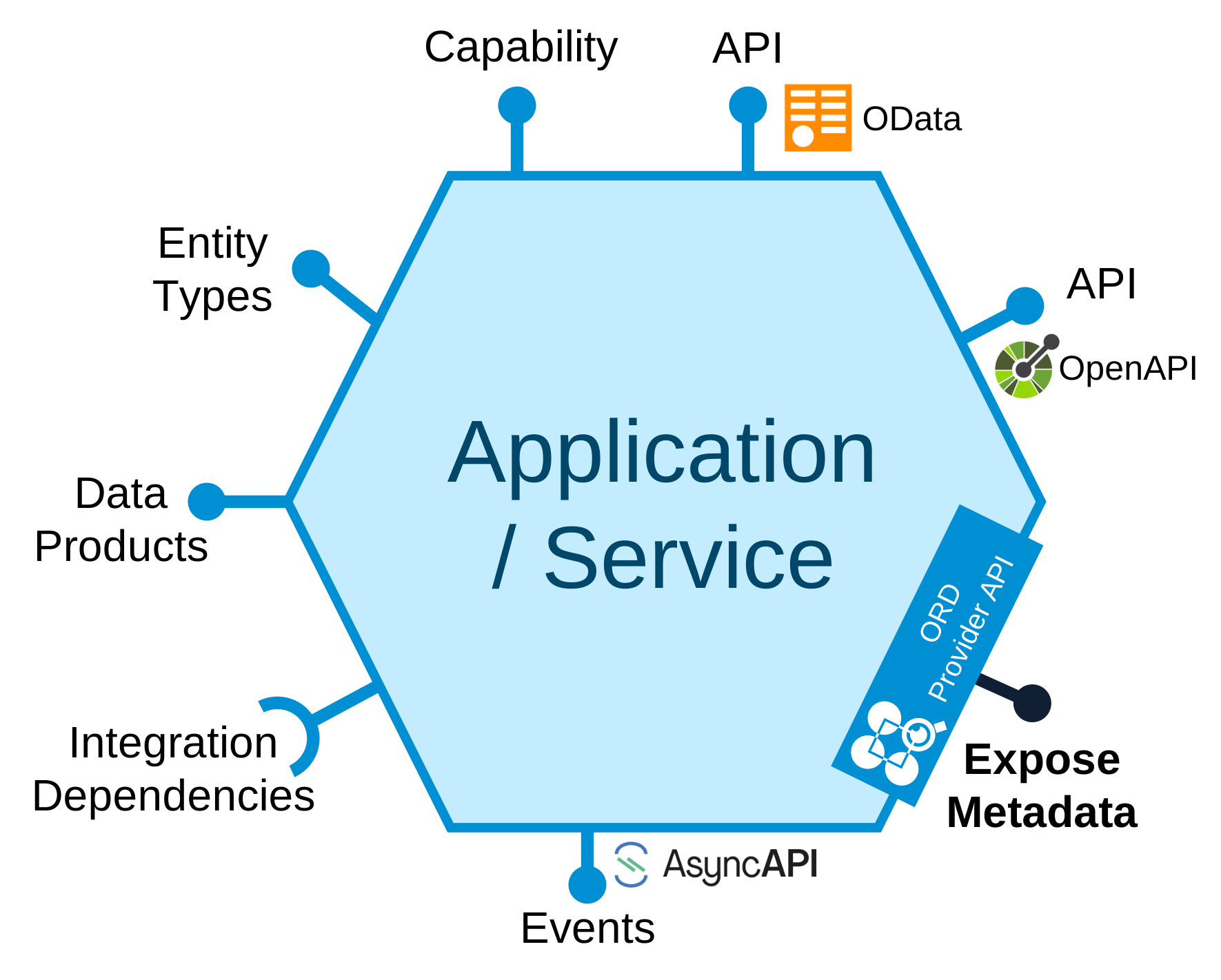
Open Resource Discovery (ORD) is a protocol that enables applications and services to self-describe their exposed resources and capabilities, standardizing metadata publishing and discovery. It serves as a foundation for metadata catalogs and marketplaces while improving integration automation and quality.
ORD is designed to be general-purpose and to work with a wide variety of industry-standard protocols and metadata standards. It can be used for static documentation or to describe the run-time system landscape, reflecting tenant-specific configuration and extensions.
Technically, ORD allows applications to implement a read-only entry point (Service Provider Interface) that can be used to discover and crawl relevant metadata. The ORD standard is governed by the Linux Foundation / NeoNephos.
Unify and Connect
Foundation for unified, well-connected metadata catalogs and marketplaces.
Multi-purpose
Covers different technologies and domains, designed to be general-purpose and extensible.
Standardized
Works with a wide variety of existing industry-standard protocols and metadata standards.
Multiple scenarios
Use it for static documentation of your offerings or runtime system landscape introspection.
Quick Start
- Understand — Read the 5-minute primer to grasp the core concepts
- Explore — Check the example files to see ORD in action
- Implement — Follow the ORD Configuration Interface to add ORD to your application
- Validate — Use the JSON Schema to validate your ORD documents
Use Cases
Information expressed or discovered through ORD can be used to build static metadata catalogs or do detailed runtime inspection of actual system landscapes:
- API and event catalog
- Data product directory/catalog
- Landscape specific API/event discovery for development platforms, platform engineering and low-code/no-code development
- Support admins in configuring services (discovery & automation)
- AI grounding & training
- Generic channel to describe, discover and exchange system capabilities between providers and consumers (even across vendors)
Design Goals
- Systems to describe themselves with a single entry-point to crawl all relevant metadata
- Achieve a combined, machine-readable system landscape metadata view
- Enable fully automatic publication and discovery of metadata
- Having one aligned standard for description of different resource types, static and runtime perspectives, and many metadata-driven use-cases
- ORD is an open standard — open source and extensible via labels, custom types, and spec extensions
Non-Goals
- Replace industry-standard resource definition formats like OpenAPI
- Describing resources or capabilities in extensive detail
- Fast-changing information (current pull-based transport is not suited for time-critical updates)
- Describing resources not owned and exposed directly by the system (self-description only)
Learn More
- Read the ORD Introduction and watch the ORD Videos
- Read blog post: Why we created Open Resource Discovery and listen to podcast on ORD
- The npm package
@open-resource-discovery/specificationprovides the JSON Schema and TypeScript types - Have questions? Ask AI about ORD (NotebookLM)